Ysbyty Ifan War Memorial
Ysbyty Ifan (Saint John) is an historic village and community situated to the southwest of Pentrefoelas, on the A5 road, in a rural area of the County Borough of Conwy, which sat in three counties: Caernarfonshire; Denbighshire; and Merionethshire. The original settlement was controlled by the Knights of St. John and had a hospital and hostel which cared for pilgrims visiting religious sites in North Wales. Situated in front of the village hall, which sits next to the village Church, is a war memorial in the form of a Celtic Cross, sat atop a pillar, which records the names of eight local men who fell during the Great War. Also added below are the details of one local man who died during WW2, who is not commemorated on the war memorial.
The Great War, 1914-1918
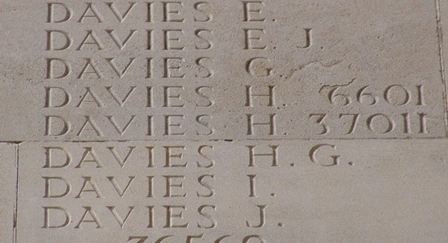
Hugh Davies, Private, 37011, Royal Welsh Fusiliers. Hugh was born in 1892, the son of David Davies and Catherine Davies (nee Morris), of 3, Glan-y-Porth, Ysbyty Ifan. He worked as a farm labourer prior to enlisting at Llanrwst into the Royal Welsh Fusiliers on 16 November 1914 and was posted to Conwy to join the 20th Battalion, Royal Welsh Fusiliers, a training unit for the 38th (Welsh) Division. On 26 May 1916 Hugh embarked at Folkestone aboard the SS Princess Henrietta and disembarked at Boulogne later that day, joining the 38th Infantry Base Depot. From there he was posted on 23 June and joined the 16th Battalion, Royal Welsh Fusiliers, which was attached to 113 Brigade, 38th (Welsh) Division. The Division had been holding a sector of the line near Cuinchy before marching south to the Somme sector in June 1916 to take part in the assault on Mametz Wood and Hugh probably joined the 16th RWF in camp at Ostreville, where it had been preparing for the Division to join the great Somme offensive. The main Battle of the Somme opened on 1 July 1916 along a wide front, and the 38th (Welsh) Division was tasked to join the fight and capture the strongly defended Mametz Wood. The first attack on the wood was launched on a two-battalion front on 7 July, but failed, and the Divisional Commander, Sir Ivor Philipps, was replaced before the Division attacked again on a two Brigade front on 10 July 1916. After two days of ferocious hand-to-hand fighting, the wood was cleared up to its northern edge, before the battered Division was relieved, however Hugh was dead, killed in action during the fighting on 10 July 1916. The 24-year-old has no known grave, so is commemorated on the Thiepval Memorial, France.
Arthur Jones, Private, 39327, Royal Welsh Fusiliers. Arthur was born in 1890, the son of Thomas Jones and Mary Jones, of Cerrig Ellt Cwm, Ysbyty Ifan. He became a schoolteacher prior to the war, and lived at The School House, Gwytherin, where he taught. On 22 February 1916 Arthur enlisted at Llanrwst into the Royal Welsh Fusiliers and was posted to the 20th Battalion, Royal Welsh Fusiliers at Kinmel Park. On 10 September 1916 Arthur embarked for the Middle East, joining the 8th Battalion, Royal Welsh Fusiliers, which was in Mesopotamia, attached to 40 Brigade, 13th (Western) Division. The Division had taken part in the Gallipoli Campaign before being evacuated to Egypt, then in February 1916 had begun to move to Mesopotamia, to strengthen the force being assembled for the relief of the besieged garrison at Kut al Amara. By 27 March, the Division had assembled near Sheikh Saad and came under orders of the Tigris Corps and then took part in the attempts to relieve Kut. However, after these efforts failed and Kut fell, the British force in the theatre was built up and reorganised. The Division then fought at the Battle of Kut al Amara, then at the capture of the Hai Salient and the capture of Dahra Bend. They took part in the passage of the Diyala, in the pursuit of the enemy towards Baghdad, and part of the Division were the first British troops to enter Baghdad after it fell on 11 March 1917. On 18 July 1917 Arthur reported himself as sick, with pains in his back and a fever. He was hospitalised, but died of heatstroke five days later, on 23 July 1917. The 27-year-old was buried in Baghdad (North Gate) War Cemetery, Iraq.
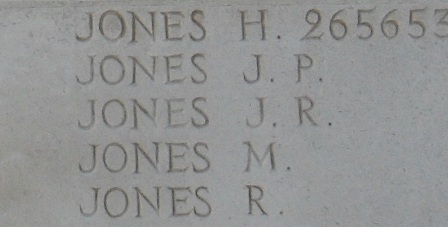
John Robert Jones, Private, 203668, Royal Welsh Fusiliers. John was born in 1897, the son of Edward Jones and Elizabeth Jones, of Hafod Ifan, Ysbyty Ifan. He enlisted into the army in Llanrwst and upon being drafted to France was posted to the 9th Battalion, Royal Welsh Fusiliers. The battalion had formed at Wrexham in September 1914, before moving to Tidworth to join 58 Brigade, 19th (Western) Division, landing in France on 19 July 1915. The Division had its baptism of fire at Loos on 25 September 1916 and in the summer of 1916 saw heavy fighting on the Somme, capturing Ovillers in the first days of the battle. Apart from a short spell refitting at Bailleul that year, the Division took part in most of the Somme offensive, then in 1917 moved to positions in the south of the Ypres Salient, taking part in the Battle of Messines Ridge on 7 June 1917. The Division then moved back to Bailleul to refit, before moving back to positions near Kemmel and took part in the opening attacks of the Passchendaele offensive on 31 July. During August the Division was withdrawn to the rear areas to rest and undertook several training regimes, before moving back to the Ypres front by the beginning of September, in readiness for another offensive. The men of the 9th RWF moved into position near Irish House on 19 September, and at 05.40 on 20 September 1917 launched an assault on Hessian Wood. John was killed in action during the fighting that day. The 29-year-old has no known grave and is commemorated on the Tyne Cot Memorial, Belgium.
John Robert Jones, Private, 37671, Gloucestershire Regiment. John was born in 1897, the son of John Jones and Elizabeth Jones (nee Derry), of 4, Mill Street, Ysbyty Ifan. He enlisted into the army at Llanrwst and was initially posted to the Monmouthshire Regiment for training however, upon being drafted to France, was posted to the 14th Battalion, Gloucestershire Regiment. The battalion was a Bantam Battalion, raised in Bristol as the West of England Battalion, before joining 105 Brigade, 35th Division and had landed in France om 20 January 1916. The Division saw its first major action during the Battle of the Somme, at the Battle of Albert in July 1916. By December 1916, the Divisional commander reported that the Division was now suffering from low physical and morale standards and many men were posted from the Division to the Labour Corps, their places being taken by men who were more physically able. The Division then went back into the line and followed the German Retreat to the Hindenburg Line in March 1917. In October 1917 the Division entrained at Péronne for Arras, before moving to Dainville to train in readiness for a move into the Ypres Salient, to join the Passchendaele offensive. By 16 October the 14th Gloucester’s had reached Proven, entraining there for Elverdinghe, before marching into the Houthulst Forest Sector. At mid-day on 22 October 1917 the battalion formed and launched an attack against the Germans in the remnants of the Houthulst Forest, but came under heavy fire, sustaining heavy casualties. John was killed in action during the attack that day, on 22 October 1917. The 20-year-old has no known grave and is commemorated on the Tyne Cot Memorial, Belgium.
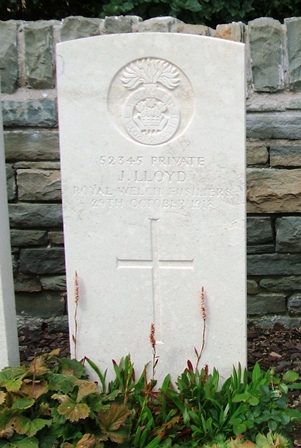
John Lloyd, Private, 52345, Royal Welsh Fusiliers. John was born in about 1890, probably the son of Benjamin Lloyd and Ann Lloyd (nee Owens), of Ysbyty Ifan. He married Kate Roberts in October 1915, and the couple made their home at Glan-y-Porth, Ysbyty Ifan. John enlisted into the army and upon being drafted to France was posted to the 17th Battalion, Royal Welsh Fusiliers, which was attached to 115 Brigade, 38th (Welsh) Division. The Division had been in France since December 1915, seeing its first major action during the assault on Mametz Wood in July 1916. It had then spent a year holding the Canal Bank at Boesinghe, before launching its assault on the Pilckem Ridge on 31 July 1917, seeing further fighting at Langemarck. Wintering in the Armentieres Sector, the Division moved to positions north of Albert, at Bouzincourt Ridge, at the end of March 1918, relieving the battered 2nd and 47th Divisions. It held this sector, again carrying out minor operations and trench raids, over the coming months. On 21 August 1918 the Division launched an assault across the River Ancre, as part of the greater Allied offensive, and over the coming days captured Thiepval Ridge, Pozieres, Mametz Wood and High Wood, whilst advancing across the old Somme battlefields of 1916. John came home on fourteen days leave in September and returned to France to rejoin the 17th RWF at Troisvillers, where it was resting following the divisions advance towards the Hindenburg Line. By 24 October the Division had reached the edge of the mighty Forest of Mormal, where there was bloody fighting for the village of Englefontaine three days later. John was killed during a raid carried out by the 17th RWF from Englefontaine on 29 October 1918, when he was reportedly shot by a sniper. The 28-year-old is buried in Englefontaine British Cemetery, France.
John Roberts, MC, Lieutenant, Royal Field Artillery. John was born in 1888, the son of Owen Roberts and Elizabeth Roberts (nee Williams), of Efail Newydd, Ysbyty Ifan. He trained as a schoolteacher prior to the war and by 1911 was lodging at Highfield, Hawarden, where he was teaching at the County School. John volunteered to serve in the 1/28th Battalion, London Regiment, the Artist’s Rifles, following the outbreak of war before being commissioned into the Royal Field Artillery and drafted to France on 20 June 1917, joining A Battery, 158th Brigade, Royal Field Artillery. The Battery was at Ypres in the autumn of 1917, supporting the Canadians in the assault on Passchendaele Ridge, then moved to Calais to re-equip with 18 Pounder guns. The Battery then supported the 15th (Scottish) Division from 20 February 1918 until 12 April; then the 3rd Division, 50th Division and 4th Division over the coming weeks. John earned the award of the Military Cross during this period. The citation for the award was published in the London Gazette of 2 July 1918, which read: 2nd Lt. John Roberts, R.F.A., Spec. Res. For conspicuous gallantry and devotion to duty. He was in charge of a party building a gun position, and when they were heavily shelled, he ordered the men to take cover. When one of the party was severely wounded, he and one man went back, and though twice knocked down by shells succeeded in carrying him to cover. 158 Battery then joined the 55th (West Lancs) Division on 11 May, supporting the Divisions assault on the Givenchy Craters. The Battery then had a brief rest before rejoining the 15th (Scottish) Division on 14 September, joining the great offensive in the summer of 1918, driving towards the Hindenburg Line from the Artois Sector. John took ill in the final days of the war, contracting influenza, which was just starting to sweep around Europe. He was evacuated to one of the Base Hospitals at Wimille, where he died of influenza on Armistice Day, 11 November 1918. The 30-year-old was buried in Terlincthun British Cemetery, Wimille, France.
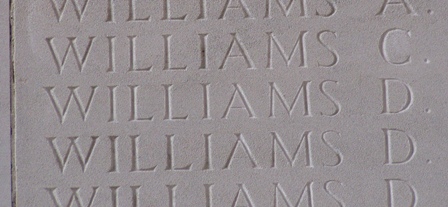
David Williams, Private, 36849, Royal Welsh Fusiliers. David was born in 1891, the son of William Williams and Elinor Williams (nee Jones), of 5, Ty Lon, Ysbyty Ifan. He worked as a farm labourer prior to enlisting into the 20th Battalion, Royal Welsh Fusiliers at Llanrwst on 15 November 1915 and was posted to Conwy. On 2 June 1916 David was drafted to France and posted from the Infantry Base Depot to the 14th Battalion, Royal Welsh Fusiliers, which was attached to 113 Brigade, 38th (Welsh) Division. The Division had been holding a sector of the line near Cuinchy before marching south to the Somme sector in June 1916 to take part in the assault on Mametz Wood and Hugh probably joined the 16th RWF in camp at Ostreville, where it had been preparing for the Division to join the great Somme offensive. The main Battle of the Somme opened on 1 July 1916 along a wide front, and the 38th (Welsh) Division was tasked to join the fight and capture the strongly defended Mametz Wood. The first attack on the wood was launched on a two-battalion front on 7 July, but failed, and the Divisional Commander, Sir Ivor Philipps, was replaced before the Division attacked again on a two Brigade front on 10 July 1916. After two days of ferocious hand-to-hand fighting, the wood was cleared up to its northern edge, before the battered Division was relieved, however David was dead, killed in action during the fighting on 10 July 1916. The 24-year-old has no known grave and is commemorated on the Thiepval Memorial, France.
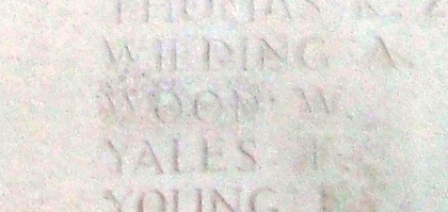
William Wood, Private, 29440, Royal Welsh Fusiliers. William was born in 1888, the son of Robert Wood and Ann Wood (nee Williams), of 3, Mill Street, Ysbyty Ifan. William had worked as a labourer prior to him and his father finding work as cotton porters in Liverpool Docks prior to the war and the pair lodged at 225, Smithdown Road, Liverpool. William enlisted into the 21st Battalion, Royal Welsh Fusiliers at Liverpool on 6 November 1915 and was initially posted to Conwy, before being posted to the 19th Battalion, Royal Welsh Fusiliers, which was attached to 119 Brigade, 40th (Bantam) Division. Early in June 1916 the division moved to France, initially to positions around Lillers before taking over the North Maroc Sector, near Loos, for trench initiation and once acclimatised was left to hold the sector itself over the coming months. The infantry battalions of the Division then began the usual routines of rotating for duty in the trenches: normally four days in the front line; four in support and four in reserve. Late in 1916 the Division moved south to the Somme, and fought at the Battle of the Ancre, before remaining in the sector over the winter. In March 1917 the Germans withdrew to their shortened line, called the Hindenburg Line, and the 40th Division was among the units which followed the withdrawal. Later in the year the Division took part in the Battle of Cambrai and launched an attack on Bourlon Wood on 23 November 1917. The attack was carried out by 119 Brigade, led by the 12th SWB and 19th RWF. The 17th Welsh was in support for the initial assault, but was soon ordered to advance, to support the two attacking battalions. Heavy fighting raged within the wood over the coming days, with the 18th Welsh also being thrown forwards into the fight, and the Division suffered terribly. William was killed in action at Bourlon Wood on the following day, 24 November 1917. The 29-year-old has no known grave and is commemorated on the Cambrai Memorial, Louverval, France.
World War Two, 1939-1945
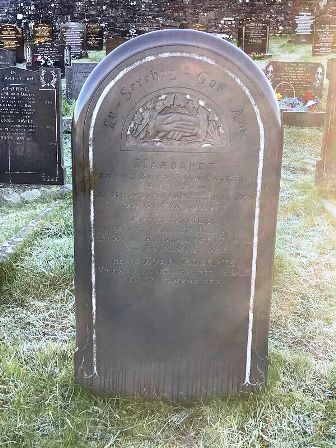
Samuel Roberts, Private, M/21024, Royal Canadian Army Service Corps. Samuel was born on 28 March 1902, the son of Evan Roberts and Margaret Roberts, of 9, Rhes Fawr, Ysbyty Ifan, Bettws-y-Coed. He had emigrated to Canada as a young man and resided at Englehill, Alberta, where he worked as a miner. Samuel enlisted into the 35th Battery, Royal Canadian Artillery, a Militia unit, in 1936 and served for two years with the battery. Upon the outbreak of war, he re-enlisted at Calgary into the Royal Canadian Army Service Corps on 20 September 1939 and on 12 June 1940 embarked for England, with the 1st Infantry Brigade Company, RCASC, before being stationed at Leatherhead, Surrey. Late at night on 16 August 1940 Samuel, together with his friend Private Thacker, were walking back to their camp at Leatherhead, when a motorcyclist overtook a car and hit Samuel, breaking his tibia and fibula. He was rushed to the nearby Royal Blind School Hospital at Leatherhead where he was given morphine and his leg was set in plaster. He appeared to be doing well, but soon after midnight, on the morning of 17 August 1940 began to choke and died, despite the efforts of the medical staff. The remains of the 39-year-old were claimed by his father, who brought him back home for burial in Ysbyty Ifan Calvinistic Methodist Cemetery, Wales. Samuel is not commemorated on the war memorial.