Pentre War Memorial
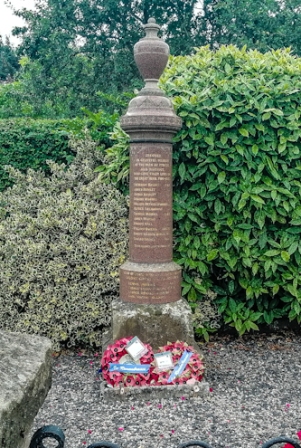
The village of Pentre lies on the northern outskirts of the town of Chirk, along the B5605 road to Newbridge, in the historic county of Denbighshire. The Pentre War Memorial commemorates those who died in both world wars and is situated on the junction of the B5605 with the minor road to Pentre. The Memorial takes the form of a red marble pillar surmounted by an urn, enclosed in a railed garden. Tragically the memorial contains the names of four members of the same Morris family, who fell in both World Wars. Many of the names of the men below also appear on the nearby Chirk War Memorial.
The Great War, 1914-1918
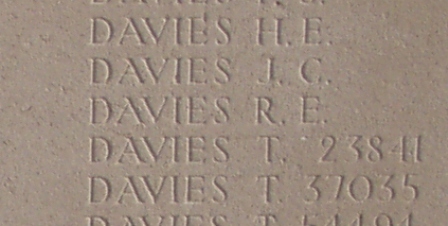
Robert Edward Davies, Private, 43602, Welsh Regiment. Robert was born in 1896, the son of Edward Davies and Sarah Davies (nee Sheldon), of 25, Plas Beunion, Ruabon. His father had died by the time that Robert enlisted into the army, and his mother moved to New Houses, Pentre. Upon being drafted to France, Robert was posted to the 16th Battalion, Welsh Regiment. The battalion, raised in Cardiff, was attached to 115 Brigade, 38th (Welsh) Division, and had been decimated during the opening assault upon Mametz Woof on 7 July 1916. Robert would have been among several hundred men drafted into its ranks as it rebuilt near Hébuterne over the following weeks. Soon afterwards the Division was transferred to the Ypres Salient, taking over the Canal Bank sector at Boesinghe. The infantry battalions of the Division then began carrying out the normal pattern of rotation in the trenches, four days in the front, four in support and four in reserve, whilst also working on trench improvement, digging new trenches, and also carrying out regular patrols and trench raids, until launching its assault upon the Pilckem Ridge on 31 July 1917, on the opening day of the Third Battle of Ypres. On 5 August the 16th Welsh was relived, moving back to Stroud Camp, to rest and refit, before moving back to the new positions at Pilckem Ridge on 18 August in support of the 20th (Light) Division, which was attempting to seize Eagle Trench. Over the coming days a German strongpoint, Pheasant Farm, stubbornly held out, so the 16th Welsh stood by in readiness to join the assault. The objective for the 16th Welsh comprised of 650 metres of trench situated along the Langemarck to Poelcapelle road, connected by pillboxes which housed machine-gun crews. The front line was held by the 11th SWB and was about 350 metres from the objective, and No Man's Land consisted purely of mud and shell-holes. The men of the 16th Welsh moved forward during the night of 26-27 August, taking up positions about 120 metres from the Germans. The weather was diabolical: it was pouring down with rain and the incessant mud and driving winds made matters all the worse. Assembly was completed by 2 am but the Cardiff City men had to lie in the mud for another twelve hours before zero, which was at 2 pm on the 27th. At around mid-day a German aircraft flying low spotted the Welshmen, and their positions were relayed back. The Germans were ready and waiting when 2 pm came and as the men stood up to advance behind their creeping barrage, the cold and wet men foundered in the knee-deep mud, forming an easy target for the German defenders. During those terrible days fighting the 16th Welsh suffered the loss of four officers and 67 men killed, seven officers and 128 men wounded, out of a total of just over 400 men. Robert was amongst the dead. The 20-year-old has no known grave and is commemorated on the Tyne Cot Memorial, Belgium.
William Arthur Edwards, Private, 55695, Royal Welsh Fusiliers. William was born in 1889, the son of William Edwards and Ellen Edwards, of Pentre, Chirk. He worked for a floor tiling company at Ruabon prior to marrying Mabel Porter in 1911 and the couple settled at Gelli Cottage, Pentre. William enlisted into the Royal Welsh Fusiliers early in the war, but was not drafted overseas for a long time, until joining the 17th Battalion, Royal Welsh Fusiliers at some time in 1916. The battalion was attached to 115 Brigade, 38th (Welsh) Division and had been on the Western Front since December 1915, taking part in the assault on Mametz Wood in July 1916. After two days of ferocious hand-to-hand fighting, the wood was cleared up to its northern edge, before the battered Division was relieved. It then took over a section of the front at Hébuterne before moving to the Ypres Salient and taking over the Canal Bank sector at Boesinghe. The infantry battalions of the Division then began carrying out the normal pattern of rotation in the trenches, four days in the front, four in support and four in reserve, whilst also working on trench improvement, digging new trenches, and carrying out regular patrols and trench raids. On 31 July 1917 the Division launched its famous assault on the Pilckem Ridge, capturing Iron Cross and reaching its objective of the Steenbeek, then played a supporting role in the Battle of Langemarck. The Division was transferred to the Sailly-sur-la-Lys sector in September and remained in the area over the winter before being moved to positions north of Albert, at Bouzincourt Ridge, at the end of March 1918, relieving the battered 2nd and 47th Divisions. It held this sector, again carrying out minor operations and trench raids, over the coming months. On 25 April 1918 the 17th RWF relieved the 13th and 16th RWF in the front line in the Bouzincourt Sector, to begin a routine spell in the trenches. William was wounded soon afterwards and was evacuated to the 131st Casualty Clearing Station where he died of his wounds on 26 April 1918. The 29-year-old was buried in Varennes Military Cemetery, France.
Alfred Fieldhouse, Private, 53612, Royal Welsh Fusiliers. Alfred was born in 1888, the son of John Fieldhouse and Elizabeth Fieldhouse (nee Rowley), of Dee Side Cottage, Newbridge, Chirk. He worked as a coal miner prior to marrying Hannah Evans in 1911 and the couple settled at Dee Side, where their two children were born over the coming years. Alfred enlisted into the Royal Welsh Fusiliers and upon being drafted to France joined the 1st Battalion, Royal Welsh Fusiliers. The battalion, attached to 22 Brigade, 7th Division, had been in India when war erupted and after sailing back to England landed at Zeebrugge on 7 October 1914, before taking part in the First battle of Ypres. The division took part in the Battle of Neuve-Chapelle the following year, and in the ensuing Battles of Festubert and Aubers Ridge. Later taking part in the Battle of Loos. During the early weeks of 1916 the division transferred south to the Somme, taking over positions east of Méaulte and took part in the opening assault of the Somme offensive on 1 July 1916, advancing from positions near Bois Francais, near Fricourt, and captured the village of Mametz, one of the few successes of 1 July 1916. The Division fought throughout the entire Somme offensive, before wintering in the Somme Valley and in the spring of 1917 followed the German withdrawal to the Hindenburg Line. The 7th Division then took part in the Battles of Arras, seeing heavy fighting around Bullecourt, before moving to the Ypres Salient to take part in the Third Battle of Ypres and moved into to encampments at Dickebusch by the end of September 1917. On 1 October the 1st RWF moved into positions at Glencorse Wood, where it was hit by a German counterattack. After a fierce firefight the Germans withdrew, and the night was relatively quiet. On the following morning, 2 October 1917, the Glencorse Wood area was subjected to a poison gas attack. Alfred was killed in action at some time during the day. The 27-year-old was originally buried on the battlefield, but after the war his grave was exhumed and re-interred in Tyne Cot Cemetery, Zonnebeke, Belgium. His grandson, George Cecil Fieldhouse, was killed in Malaya in 1956.
Edward Hall, Private, 28992, South Wales Borderers. Edward was born in 1884, the son of William Hall and Martha Hall, of Cross Lanes, Kinnerley, Shropshire. By 1901 Edward was residing with his cousin, Andrew Kelsall, at Clinton Terrace, Cefn, Rhosymedre, and his parents had moved to Ty Maen Farm, Pentre. Edward worked as a farm labourer prior to enlisting into the army and upon being drafted to France was posted to the 10th Battalion, South Wales Borderers, which was attached to 115 Brigade, 38th (Welsh) Division. The Division had been on the Western Front since December 1915, taking part in the assault on Mametz Wood in July 1916. After two days of ferocious hand-to-hand fighting, the wood was cleared up to its northern edge, before the battered Division was relieved. It then took over a section of the front at Hébuterne before moving to the Ypres Salient and taking over the Canal Bank sector at Boesinghe. The infantry battalions of the Division then began carrying out the normal pattern of rotation in the trenches, four days in the front, four in support and four in reserve, whilst also working on trench improvement, digging new trenches, and carrying out regular patrols and trench raids. On 31 July 1917 the Division launched its famous assault on the Pilckem Ridge, capturing Iron Cross and reaching its objective of the Steenbeek, then played a supporting role in the Battle of Langemarck. Edward was wounded at some time after the battle, probably whilst 115 Brigade was in support of the 20th (Light) Division at Langemarck. He was evacuated to the Base Hospital at Étaples, where he died of his wounds on 25 August 1917, aged 34. Edward was buried in the vast Étaples Military Cemetery, France.
Alfred Hamblett, Private, 54944, Royal Welsh Fusiliers. Alfred was born at Barrow-in-Furness in 1883, the son of James Hamblett and Hannah Hamblett (nee Ashley). His parents died when he was young and he was raised by his grandparents, Samuel and Elizabeth Hamblett, at 8, Pentre Cottage, Chirk. Alfred worked as a general labourer prior to the war, before enlisting into the army. He was drafted to France at some time in 1916, joining the 10th Battalion, Royal Welsh Fusiliers, which was attached to 76 Brigade, 3rd Division. The battalion had been in France since landing at Boulogne on 27 September 1915, spending its first few weeks undergoing trench initiation, before taking over the line at St. Eloi, near Ypres. The Division saw heavy fighting during the Actions of the Bluff in February 1916 and then at the Actions of the St Eloi Craters from 27 March to 16 April. The battalion continued to suffer during these months at St. Eloi, coming under a gas attack for the first time on 29/30 April. By the middle of June, the Division had moved out of the Ypres Salient to billets around Eperlecques, where intense training was carried out prior to moving to the Somme sector by 2 July. The main Somme offensive had opened on the previous day, and the 3rd Division was ready to enter the fray, bivouacking at Bronfay Farm by 9 July and on 13 July moved into the captured German lines at Montauban Alley. The 10th RWF took part in heavy fighting over the coming days, and on 19 July received orders for an assault on Delville Wood. Just after midnight the following day the battalion moved forwards and became caught in in terrible fighting within the wood, the fighting of such severity that two men of the battalion were awarded the Victoria Cross. On 25 July the shattered battalion was relieved and moved into reserve and did not move back into the line until 17 August, when the battalion attacked Lonely Trench. On 23 August the Division moved out of the line to rest and moved to Noeux-les-Mines, near Loos. After a month there, the Division moved back into a rest area for further training before moving back south to the Somme and by 12 November took over trenches at Serre. On the following day, 13 November 1916, the Division launched an assault against the German positions at Serre, suffering almost 300 officers and men killed, wounded, or missing. In May 1917 the Division was at Arras, taking part in the First and Second Battles of the Scarpe, and in the Battle of Arleux and the Third Battle of the Scarpe, where it captured Roeux. On 17 September the 10th RWF entrained for Godewaersvelde, detrain on the following day before the division moved into positions at Ypres. On the night of 25 September, the 10th RWF crossed the Hannebeke, moving into position to launch an assault against the wood on the following morning. During the early hours of 26 September 1917, following a heavy artillery bombardment, the men of the 10th Welsh crossed the Zonnebeke, and attached the ruined village of Zonnebeke. The men were met with heavy machine-gun fire and suffered heavily, before having to fight off a German counterattack. Alfred was killed in action at sometime during the day. The 34-year-old has no known grave and is commemorated on the Tyne Cot Memorial, Zonnebeke, Belgium. His brother, James, had been killed earlier that year.
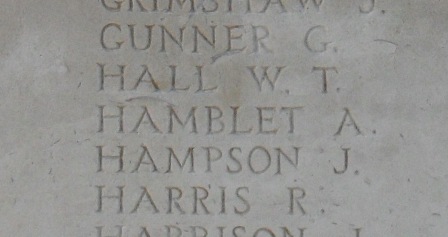
James Hamblett, Private, 53622, Royal Welsh Fusiliers. James was born in Ruabon in 1891, the son of James Hamblett and Hannah Hamblett (nee Ashley). His parents died when he was young and he was raised by his grandparents, Samuel and Elizabeth Hamblett, at 8, Pentre Cottage, Chirk. James worked as a bricklayer prior to enlisting into the army and upon being drafted to France was posted to the 1st Battalion, Royal Welsh Fusiliers. The battalion, attached to 22 Brigade, 7th Division, had been in India when war erupted and after sailing back to England landed at Zeebrugge on 7 October 1914, before taking part in the First battle of Ypres. The division took part in the Battle of Neuve-Chapelle the following year, and in the ensuing Battles of Festubert and Aubers Ridge. Later taking part in the Battle of Loos. During the early weeks of 1916 the division transferred south to the Somme, taking over positions east of Méaulte and took part in the opening assault of the Somme offensive on 1 July 1916, advancing from positions near Bois Francais, near Fricourt, and captured the village of Mametz, one of the few successes of 1 July 1916. The Division fought throughout the entire Somme offensive, before wintering in the Somme Valley and in the spring of 1917 followed the German withdrawal to the Hindenburg Line, taking over positions near Courcelles. James was killed in action on 30 March 1917 whilst the 10th RWF was moving into positions at Bavillers, in front of the village of Puisieux. The 25-year-old has no known grave and is commemorated on the Arras Memorial, France. His brother, Alfred, was killed at Ypres later that year.
Edward Whitfield Hughes, Private, 3110, Australian Infantry. Edward was born on 29 April 1884, the son of Edward Hughes and Elizabeth Hughes (nee Whitfield), of Plas Offa, Chirk. He was educated at Llangollen County School before leaving Wales in 1909 to start farming in Australia, and settled at Toowoomba, Queensland. Following the outbreak of war Edward, like many other British emigrants, enlisted into the Australian Infantry, attesting at Brisbane on 28 July 1915. He embarked from Brisbane, Queensland, on board HMAT A50 Itonus on 30 December 1915, with the 7th Reinforcement Draft for the 25th Battalion, AIF, joining the battalion in Egypt following its service at Gallipoli. After further training in Egypt, the 25th Battalion proceeded to France and became the first Australian unit to land there, disembarking at Marseilles on 19 March 1916 as part of the 2nd Division. The 2nd Australian Division saw its first major action in France during the bloody Battle of Pozieres, which raged from 25 July and 7 August, suffering some 785 casualties. After a spell in a quieter sector of the front in Flanders, the 2nd Division moved back to the Somme in October and saw heavy fighting during two attacks to the east of Flers, both of were halted by the mud. After wintering in the Somme Valley, the battalion moved with the 2nd Division to the Arras Sector, and during this move, on 18 March 1917, Edward transferred to the 7th Australian Light Trench Mortar Battery. Edward was killed in action during the terrible fighting for Bullecourt on 5 May 1917, within weeks of joining his new unit. The 33-year-old has no known grave and is commemorated on the Villers-Bretonneux Memorial, France.
Frederick Hughes, Private, 200363, Royal Welsh Fusiliers. Frederick was born in 1896, the son of John Hughes and Mary Ann Hughes, of Offa Cottage, Froncysyllte. His father died when he was young, so Frederick found work as a horse driver in a local colliery. He enlisted into the Royal Welsh Fusiliers soon after the outbreak of war, becoming one of the first Pentre men in France when he disembarked with the 4th Battalion, Royal Welsh Fusiliers on 6 November 1914, joining 3 Brigade, 1st Division at Bailleul. The Division had been one of the first to arrive in France, fighting at the Battle of Mons, and taking part in the retreat to the Marne, where the Germans were stopped. It had then taken part in the Battle of the Aisne, and at Chivy Ridge, where the German drive on Paris was stopped, before being moved north to Ypres. The division then saw terrible fighting as the BEF dug in to0 stop the Germans reaching the Channel coast, defending the city of Ypres, and forming the Salient which would last for the remainder of the war, before wintering in Flanders. The following year saw the 1st Division in action again at the Battle of Aubers Ridge, where heavy casualties were suffered for no gain. On 1 September 1915 the 4th RWF transferred to the 47th Division, as the Divisional Pioneer Battalion. On 25 September the Division took part in the Battle of Loos and in the subsequent Action of the Hohenzollern Redoubt. During the following Spring it was holding the line north of Arras when the Germans attacked Vimy Ridge, and after a furious defensive action moved south to the Somme, taking part in the Battle of Flers-Courcelette, and then at the Battle of Le Transloy, where the Division captured Eaucourt l'Abbe. The Division then took part in the Attacks on the Butte de Warlencourt. Early in 1917 the Division moved north to Belgium and took part in the Battle of Messines Ridge on 7 June 1917. The 4th RWF was by now stationed at Chippawa Camp, providing working parties to dig, strengthen and repair the network of trenches held by the 47th Division. On 9 September 1917 the battalion was at work on defences around Belgian Chateau when Frederick was killed in action, probably by German artillery fire. The 21-year-old is buried in Birr Cross Roads Cemetery, Belgium.
Edward Morris, Private, 75245, Royal Welsh Fusiliers. Edward was born at West Bromwich in 1878, the son of James Morris and Louisa Morris (nee Jesson). The family had moved to Chirk by 1881, settling at Penybont, Pentre. Edward found work as a labourer after leaving school, then on 23 November 1901 married Elizabeth Edwards, of Pentre, before the couple made their home at Sun Bank, Pentre. He enlisted into the army at Chirk, prior to being drafted to France and posted to the 13th Battalion, Royal Welsh Fusiliers. The battalion had been raised at Rhyl before embarking for France in December 1915, attached to 113 Brigade, 38th (Welsh) Division, taking part in the attack on Mametz Wood in July 1916 and in the assault on Pilckem Ridge on 31 July 1917 before playing a supporting role in the Battle of Langemarck. The Division was transferred to the Sailly-sur-la-Lys sector in September and remained in the area over the winter before being moved to positions north of Albert, at Bouzincourt Ridge, at the end of March 1918, relieving the battered 2nd and 47th Divisions. It held this sector, again carrying out minor operations and trench raids, over the coming months, and it was during the latter period that Edward joined the ranks of the 13th RWF, from the Infantry base Depot. On 21 August 1918 the Division launched an assault across the River Ancre, as part of the greater Allied offensive, and over the coming days captured Thiepval Ridge, Pozieres, Mametz Wood and High Wood, whilst advancing across the old Somme battlefields of 1916. The advance saw the Division take part in several costly assaults over the coming weeks, famously crossing the Canal du Nord. By 5 October the 13th RWF had reached the Le Catelet-Nauroy line, in support of the 14th RWF, then on 8 October 1918 took part in an assault by the 38th (Welsh) Division on the strongly defended Mortho Wood. Edward was killed in action during the assault that day. The 40-year-old was buried in Moulin-de-Pierre British Cemetery, France. His nephew, James Morris, and his brother, Thomas Morris, also fell during the war, whilst another nephew, Dennis Morris, fell in WW2.
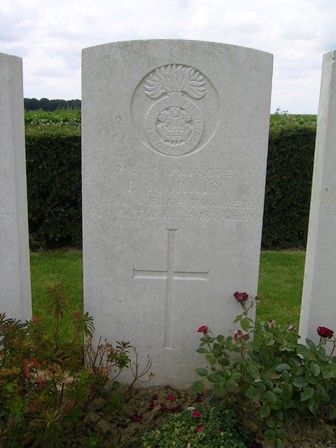
James Morris, Private, 35395, South Wales Borderers. James was born in 1896, the son of Enoch Morris and Sally Morris (nee Furmston), of 3, Park Terrace, Cefn Mawr. The family later moved to Penybont Cottage, Pentre. James enlisted into the army soon after the outbreak of war and was posted to France, joining the 12th Battalion, South Wales Borderers. The battalion was raised at Newport by the Welsh National Executive Committee in March 1915 as a bantam Battalion, then in July 1915 moved to Prees Heath to join the Welsh Bantam Brigade. During September 1915 the Brigade moved to Aldershot and became 119 Brigade, in the 40th (Bantam) Division. In December 1915 the Division moved to Blackdown to complete its training before embarking for France and landing at Le Havre on 2 June 1916. The Division moved to positions around Lillers before taking over the North Maroc Sector, near Loos, for trench initiation and once acclimatised was left to hold the sector itself over the coming months. The infantry battalions of the Division then began the usual routines of rotating for duty in the trenches in the Calonne-Sur-La-Lys Sector: normally four days in the front line; four in support and four in reserve. Whilst holding the line on the night of 9/10 August, the Germans opened an artillery barrage upon the 12th SWB, wounding four men. One of the wounded was James, who died of his wounds later that day, on 10 August 1916. The 19-year-old was buried in Chocques Military Cemetery, France. His uncles, Thomas Morris and Edward Morris, also fell during the war, whilst his younger brother Dennis was killed in WW2.
Thomas Morris, Private, 33940, South Wales Borderers. Thomas was born in 1886, the son of James Morris and Louisa Morris (nee Jesson). The family had moved to Chirk by 1881, settling at Penybont, Pentre. Thomas worked as a labourer prior to marrying Mary Elizabeth Edwards, and the couple settled at Park Road, Newbridge. Thomas enlisted into the army and was posted to Egypt early in 1916 to join the 4th Battalion, South Wales Borderers. The battalion was attached to 40 Brigade, 13th (Western) Division and had taken part in the ill-fated Gallipoli Campaign before being evacuated to Egypt on 8 January 1916, concentrating at Port Said, where it held forward posts in the Suez Canal defences. On 12 February 1916 the Division began to move to Mesopotamia, to strengthen the force being assembled for the relief of the besieged garrison at Kut al Amara, but the relief failed, and Kut fell to the Turks. The Division then took part in the advance through Mesopotamia, which was to successfully liberate the country from centuries of Ottoman rule. On 11 January 1917 the 4th SWB took over trenches along the Hai River, guarding a vital bridgehead and supplying working parties to build an arms dump, in readiness for a forthcoming assault. Thomas was killed in action there on 23 January 1917, the war diary only stating that the battalion was working on these arms dumps. The 30-year-old has no known grave and is commemorated on the Basra Memorial, Iraq. His brother, Edward Morris and nephew, James Morris, also fell in WW1, whilst another nephew, Dennis Morris, fell in WW2.
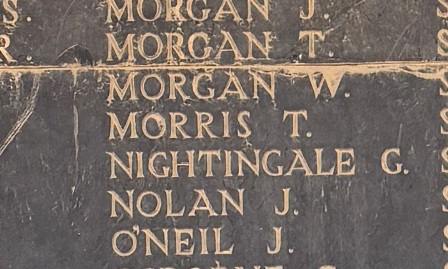
William Owens, Private, 11760, Lincolnshire Regiment. William was born in 1894, the son of Owen Owens and Mary Owens (nee Evans), of Pentre. He worked as a railway porter prior to enlisting into the army soon after the outbreak of war and was posted to the 7th Battalion, Lincolnshire Regiment. The battalion was raised at Lincoln in September 1914, moving to Wool to join 51 Brigade, 17th Division, then in June 1915 moved to Flower Camp, Winchester to complete its training. On 14 July 1915 William landed at Boulogne with the battalion, which camped at Ostrohove before moving by route march towards Pont-Des-Briques, where the battalion entrained for Wizernes, near St. Omer. On 18 July the battalion marched to Wallon Cappel, and on the following day to Eecke, from where a party of officers was despatched to Ypres, to reconnoitre the trenches the battalion was to be moved into. The Division then spent its initial period of trench familiarisation in the southern area of the Ypres salient, near Reninghelst, before a period in the trenches at Hooge. The coming months in the line were relatively quiet for the Division, but this all changed after the division moved slightly south, to the Bluff Sector, at the beginning of February 1916. On 14 February the Germans exploded an underground mine, collapsing a British tunnel system and demolishing a section of front-line parapet, and over the coming days fighting raged for the Bluff Sector, both on the ground and underneath, in the tunnels. The 7th Lincolns had suffered a number of casualties during the early fighting, before being relieved on 17 February by the 2nd Suffolks, moving back to camp at Reninghelst to rest, before preparing to rejoin the action. On 1 March the battalion moved back into the trenches and began to assemble to launch an assault against the Germans at The Bluff. William was killed in action during this attack on the following day, 2 March 1916, which resulted in the battalion attaining all its allotted objectives. The 24-year-old has no known grave and is commemorated on the Menin Gate Memorial, Ypres.
World War Two, 1939-1945
George Ronald Johnson, Flight Sergeant, 1270575, Royal Air Force Volunteer Reserve. George was born Bucklow, Cheshire in 1921, the son of George Johnson and Harriet Elizabeth Johnson (nee Davies). His mother was from The Hollow, Whitehurst, Chirk. George enlisted into the Royal Air Force Volunteer Reserve soon after the outbreak of war and trained as a pilot. Whilst on leave in the summer of 1942 he married Constance Caroline Emily Marshall, of Shrewsbury. By now, George had been attached to No. 4 Signals School, which was based at RAF Madley, in Herefordshire, and he and Constance set up home together at 2, Barton Villas, Barton Road, Hereford. On 6 September 1942 George took off from RAF Madley, flying a Percival Proctor II, Serial Z7250, on a routine training flight, but tragically collided with another Proctor, of No. 4 Signals School, and both aircraft crashed at Brampton Hill, six miles southwest of Hereford, killing both George and the pilot of the other aircraft. George was just 20 years old when he was killed that day and was buried in Shrewsbury General Cemetery.
**Dennis Morris, Fusilier, 14739195, Royal Welch Fusiliers.**Dennis was born on 22 April 1912, the son of Enoch Morris and Sally Morris (nee Furmston), of Penybont Cottage, Pentre. He worked as a brickyard labourer prior to the war, then in 1940 married Jessie Edwards, of Newbridge. Dennis enlisted into the army and was posted to the 6th Battalion, Royal Welch Fusiliers, a Territorial Army unit which was attached to 158 Brigade, 53rd (Welsh) Division. The battalion was mobilised at the outbreak of war, when the Division moved to Northern Ireland to begin garrison duties. The Division then moved to Pembroke Dock, before moving again to the south of England, where it trained in readiness for the D-Day Landings. On 24 June 1944 the 7th RWF left England for Normandy, and landed at La Riviere near Ver Sur Mer. The Division then took part in heavy fighting over the coming weeks, as part of the effort to break-out of the Normandy beachhead, seeing heavy fighting at Évrecy, before starting the epic advance through Northern France into Belgium and Holland. On 15 September the Division forced the crossing of the Junction Canal North of Lommel, and continued to push westwards towards Elst, between Nijmegen and Arnhem, during Operation Market Garden. On 22 October the Division launched its famous assault on ‘s-Hertogenbosch, before continuing its advance to the German frontier. Between December 1944 and January 1945, the Division took part in the Battle of the Bulge, helping in the counterattack which helped save the Americans, who were under heavy pressure, then after the German offensive was broken, took part in heavy fighting to enter the Rhineland, taking part in Operation Veritable, the battle of the German Reichswald. Dennis was wounded during the battle and died of his wounds in Sint Michielsgestel on 10 February 1945. The 32-year-old is buried in Uden War Cemetery, Netherlands. His uncle, Edward Morris, and elder brother, James Morris, were both killed in WW1.
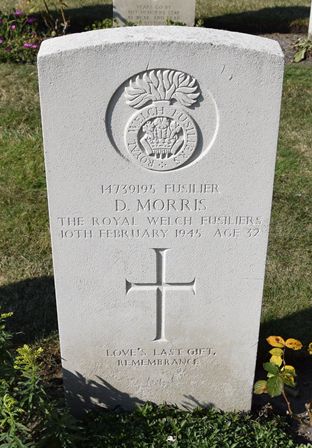
George Edwin Phillips, Sergeant, 1530967, Royal Air Force Volunteer Reserve. George was born in 1922, the son of Harry Phillips and Isabella Oughton Phillips (nee Stevenson), of 4, New Houses, Pentre. He married Freda Annie Jones, of 33, Chapel Street, Rhosymedre in 1942. George had already enlisted into the Royal Air Force Volunteer Reserve by then and had trained as a Wireless Operator/Air Gunner. He was attached to 44 Squadron, Royal Air Force, a heavy bomber unit which was based at RAF Dunholme Lodge, Lincolnshire. On the night of 24 December 1943 George took off from Dunholme Lodge aboard an Avro Lancaster III, Serial ED999, which was part of a large bomber group despatched to strike Berlin. George, along with the rest of his crew, were killed when their Lancaster was shot down by a night fighter and crashed at Vechta, near Diepholz, on the outward journey. The 22-year-old was buried together with the other six crew in a collective grave in Hanover War Cemetery, Germany.
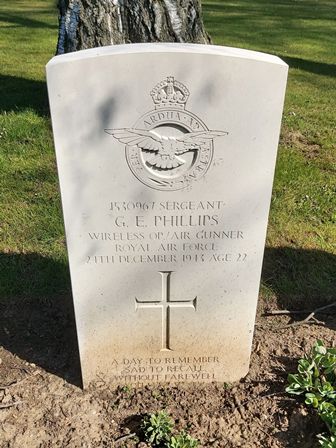
Carl Vincent Williams, Sergeant, 999235, Royal Air Force Volunteer Reserve. Carl was born on 8 March 1918, the son of Walter Kingsley Williams and Ethel Williams (nee Evans), of Sun Bank, Pentre. The family later resided at Rhos-Y-Waen, Chirk before his parents divorced and Carl then moved with his mother and brother to 19, John Street, Chirk. Carl worked as a laboratory assistant and was a member of the ARP prior to leaving Chirk to enlist into the Royal Air Force Volunteer Reserve and trained as a Wireless Operator/Air Gunner before being posted to 9 Squadron, a heavy bomber unit based at RAF Honington, Suffolk. On the night of 13 April 1942 Carl took off from Honington aboard a Vickers Wellington III, Serial X3722, which joined a large bomber group despatched to strike targets in Essen. Carl was killed, together with four other members of his crew, when their Wellington was shot down and crashed at Moers-Vinn, near Duisberg, that night. The 24-year-old was buried with his fellow crewmen in Reichswald Forest War Cemetery, Germany.
Malayan Emergency
George Cecil Fieldhouse, Fusilier, 23129235, Royal Welch Fusiliers. George was born on 22 November 1936, the son of John Alfred Raymond Fieldhouse and Mair Fieldhouse (nee Humphreys), of 2, Bron Newlog, Wrexham. He enlisted into the Royal Welch Fusiliers, probably as a National Serviceman, and was posted to Malaya with the 2nd Battalion, Royal Welch Fusiliers, as a result of the Malayan Emergency. The conflict in Malaya was a result of a guerilla campaign staged by communist pro-independence fighters of the Malayan National Liberation Army and the forces of the Federation of Malaya and the British Empire, hoping to gain independence from Britain. On 11 August 1954 the battalion embarked from Southampton bound for Korea, but en-route its destination was switched to Singapore, from where the battalion moved to Malaya. George was killed in Malaya on 29 April 1956, aged just 19. He is buried in Cheras Road Christian Cemetery, Malaysia. Although not named on the Pentre War Memorial, I have added his details here, since his grandfather, Alfred Fieldhouse, was killed in WW1, and is named on the memorial.