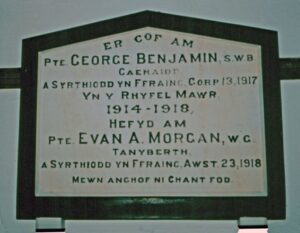
Cwmrheidol (Rheidol Valley) is reached from the A44 road from Capel Bangor, and is about eight miles east of Aberystwyth. The valley was once home to a thriving mining community, but has since become better known for its beauty, and for the hydro-electric power station. This page commemorates the men on the War Memorial at Llwyn-y-Groes Chapel, at Cwmrheidol. The men who fell during World War Two are commemorated on a small brass engraved plaque, which is within St John’s Church, at Ysbytty Cynfyn.
The Great War, 1914-1918
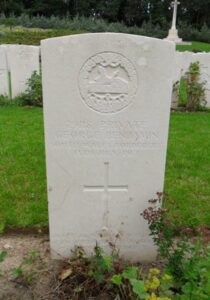
George Benjamin, Private, 29118, South Wales Borderers. George was born at Llanbadarn in 1887, the son of Thomas and Margaret Benjamin. The family later resided at Caehaedd, Cwmrheidol. George enlisted at Brecon into the South Wales Borderers, and was posted to France early in 1916, where he was posted to the 1st Battalion, South Wales Borderers, which was attached to 3 Brigade, 1st Division. The Division had suffered heavy casualties at Loos in 1915, and in 1916 moved to the Somme. Here it took part in the Battle of Albert, and fought at Bazentin, Pozières, Flers-Courcelette and Morval. The Division followed the German retreat to the Hindenburg Line in early 1917, before moving to the Flanders Coast during the summer of 1917. George was killed in action here on 13 July 1917. He was 30 years old, and is buried at Coxyde Military Cemetery, Belgium.
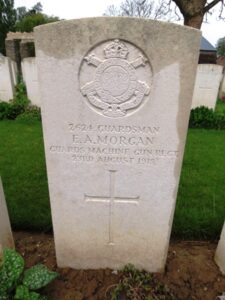
Evan Arthur Morgan, Private, 2624, Guards Machine Gun Regiment. Evan was born at Aberffrwd in 1892. He worked as a Waggoner at a farm in London prior to the war, before enlisting into the Welsh Guards. Evan was posted to the 4th Battalion, Guards Machine Gun Regiment, after its formation on 10 May 1918. The battalion was attached to the famous Guards Division, and was stationed north of the Somme. On 8 August the Australian Corps advanced towards the town of Villers Brettoneux and won a mighty battle there against the Germans, thus turning the war. On 21 August the British launched an attack on the Somme, and the Guards Division fought here at the Battle of Albert, driving eastwards towards Bapaume over the coming days. Evan was killed during the initial advance, on 23 August 1918. He was 26 years old, and is buried at Douchy-Les-Ayette British Cemetery, France.
World War Two, 1939-1945
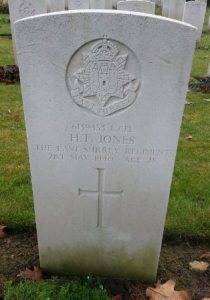
Harold Teify Jones, Lance Corporal, 6139353, East Surrey Regiment. Harold, known as Teify, was born in 1912, the son of Isaac Jones and Emily Jones, of Tegfan, Ponterwyd. He had enlisted into the army in 1940 and by the time that war was declared upon Germany was serving with the 1st Battalion, East Surrey Regiment. Teify had spent the first eight years with the Battalion in India, then in 1938 the Battalion moved to the Sudan, where a number of men of the Battalion became employed as extras in the filming of The Four Feathers. The Battalion returned to England in February 1939, as part of the 11th Infantry Brigade, 4th Infantry Division and was sent to France with the British Expeditionary Force (BEF) in October and over the coming months prepared for a possible German invasion of France and the Low Countries. Teify came home on leave from France for the last time in February 1940, spending a few days with his parents before returning to the front. Early on 10 May 1940 the Germans began their invasion and quickly broke the French lines, forcing the BEF to withdraw to avoid becoming surrounded, and began their fighting retreat towards Dunkirk. Teify was killed in action during the retreat to Dunkirk, on 21 May 1940. He was 28 years old and is buried in Heverlee War Cemetery, Belgium.
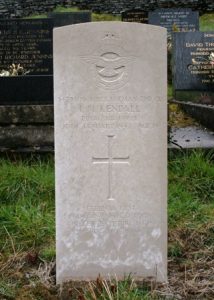
Ivor Martin Kendall, Aircraftman 2nd Class, 1470879, Royal Air Force Volunteer Reserve. Ivor was born on 27 April 1922, the son of Ivor James Kendall and Sarah Kendall (nee Powell), of Erwyd View, Ponterwyd. He worked as a bus conductor for the Crosville Bus Company at Aberystwyth prior to enlisting into the Royal Air Force Volunteer Reserve, and was posted to RAF Halton, in Buckinghamshire. Ivor was about to come home for his first leave since joining the forces, when he suddenly became ill, and died of pneumonia at Halton on 10 January 1942. The body of the 19-year-old was brought home and he was buried with full military honours, including members of the local Home Guard and Royal Observer Corps, in St. John’s Churchyard, Yspytty Cynfyn on the following day. Tragically one of his brothers, John, who was in the cortege, died two years afterwards.
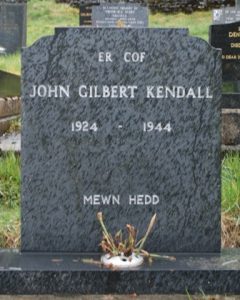
John Gilbert Kendall, Air Observer, Royal Observer Corps. John was born on 24 March 1924, the son of Ivor James Kendall and Sarah Kendall (nee Powell), of Erwyd View, Ponterwyd. He worked as an assistant in a grocery shop, before enlisting into the Royal Observer Corps, a civil defence organisation intended for the visual detection, identification, tracking and reporting of aircraft over Great Britain, which operated from look-out posts scattered all around the country. John attended the funeral of his elder brother Ivor on 11 January 1942, but tragically two years later, almost to the day, on 12 January 1944, died aged 19. John was buried in St. John’s Churchyard, Yspytty Cynfyn. He is not commemorated as an official war casualty.
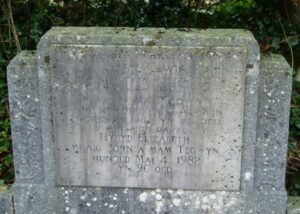
Tegwyn Mason Lewis, Lance Corporal, 14531306, Reconnaissance Corps. Tegwyn was born in 1921, the son of John Lewis and Elizabeth Lewis (nee Davies), of Brynchwith, Ponterwyd. He enlisted into the army after the outbreak of war and became posted to “C” Squadron, 52nd (Lowland) Reconnaissance Regiment, which was attached to the 52nd (Lowland) Division. The Division spent most of the war in Britain, training for a possible invasion of Norway, but became converted to and airlanding unit, becoming transferred to the First Allied Airborne Army. The Division remained unused throughout the Normandy campaign, however it was transferred to Belgium via sea landing in Ostend during the first week of October 1944, to take part in an amphibious attack across the Leopold Canal as part of the First Canadian Army, in conjunction with Operation Market Garden, the attempt to force the Rhine Crossing at Arnhem. The division’s first operation was to take part in the assault to open the vital Belgian port of Antwerp, in the Battle of the Scheldt, with amphibious landings to capture South Beveland and the island of Walcheren to open the mouth of the Scheldt Estuary. Tegwyn was killed in action during the heavy fighting here on 25 October 1944. The 23-year-old was originally buried in Maldegem Canadian Temporary Burial Ground, then in July 1945 the burials in the cemetery were exhumed and re-interred into Adegem Canadian War Cemetery near Antwerp, Belgium. Tegwyn is buried beside two of his comrades in “C” Squadron killed on the same day; Troopers Frederick Heath and Charles James Purser. Tegwyn is also commemorated on his parents headstone at Ponterwyd.
Daniel Arllwyd Richards, Fusilier, 14308360, Royal Fusiliers (City of London Regt). Daniel was born on 13 January 1924, the son of Enos Brinley Richards and Annie Letitia Richards (nee Williams), of Bwlch-y-Brynau, Ystumtuen. He enlisted into the army and was posted to the 9th Battalion, Royal Fusiliers, a Territorial Army unit, which was attached to the 167th Infantry Brigade, 56th (London) Infantry Division. The Division spent the early part of the war on home defence duties, then in June 1942 received orders to prepare for overseas service, embarking in August for Iraq via Bombay. By the time the division arrived in Basra, any threat to Iraq from Germany had gone, so after several months training in the Kirkuk area, the division moved to Tunisia via Palestine, seeing its first action at Enfidaville on 9 May 1943, just days before the surrender of the Afrika Korps. The Division then began to prepare for the amphibious landings on Italy, becoming attached to 10 Corps, 5th US Army for Operation Avalanche, the landing at Salerno. The 9th Battalion Royal Fusiliers became part of the first wave that landed at Salerno on 9 September 1943, before advancing inland and occupied Battipaglia the following day, before suffering terribly during a German counter-attack which retook the town. The battalion then received large numbers of reinforcements, probably Daniel amongst them, before taking part in the advance to the Volturno and then on towards the Bernhardt Line, including the second battle of Monte Camino. Daniel was killed in Italy just after this period, being reported as wounded and missing on 19 December 1943. No trace of the 19-year-old was ever found, so he is commemorated on the Cassino Memorial, Italy.